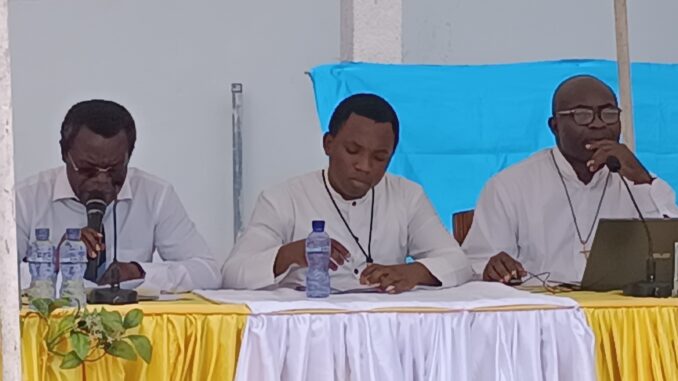
After the Mass celebrated on Saturday, January 25, in the chapel, it was in the courtyard of the scholasticate Saint Eugene de Mazenod of Kinshasa-Kintambo that the opening session of the bicentenary of the Constitutions and Rules continued. Two jurists, Fathers Guy Ndombe and Clement Fiyungu, took part in a conference on the why of the book of Constitutions and the history of the updates of this book since the founding of the congregation by Saint Eugene de Mazenod.

Basic reference
Father Guy Ndombe presented the Constitutions and Rules as roots, a fundamental reference for the charism of a religious institute and a link with the universal Church. The Constitutions are also a binding normative value and therefore a source of unity and centrality. He stressed that this book requires renewal and adaptation.
A promise of life
Father Clement Fiyungu recalled the Holy Scriptures to explain how much obedience to God's commandments is a promise of life. He presented the Constitutions and Rules as a help to better understand and live evangelical requirements for personal development in religious life and in the community.
In particular, Father Fiyungu reviewed the 12 different revisions of the Oblate Constitutions and Rules in 35 general chapters. Each time, it is a matter of meeting contemporary challenges while remaining faithful to the source.
Negotiated and approved text
A group of scholastics presented a saynete reproducing the beginning of the history of the Constitutions and Rules. Eugene de Mazenod and his first companions had negotiated to obtain, in dialogue, the text which the Church, by Pope Leo XII, approved on February 17, 1826, 200 years ago.




Be the first to comment