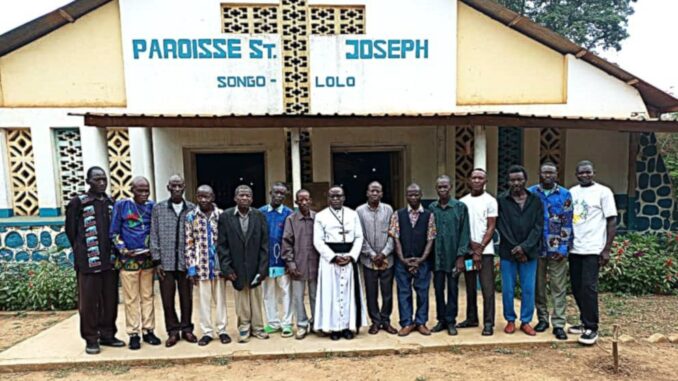
From 15 to 18 January 2026, the parish of Saint Joseph of Songolo, in the diocese of Matadi (DRC), organized an important training session for its catechists. The event, opened during the prayer of the Vespers by Father Berthier EYER, OMI, parish priest, and by Mr. Mampuya, first vice-president of the parish council, is part of the process of pastoral strengthening desired by the local Church.
The formation was held simultaneously in two centres: Songololo and Mbanza-Matadi, located about 85 km from the mission, in order to allow for a wide participation of catechists from the different pastoral areas.
The heart of the session was the restitution of the teachings received in September 2025 at the Pastoral Centre in Tumba, during a diocesan formation led by the abbots responsible for the supervision of catechists. Two catechists from the parish, who took part in this session, shared a doctrinal and liturgical condensation enriched by pastoral lighting adapted to local realities.
Two major modules were added to these lessons:
– the necessity and methodology of writing the catechist's activity reports,
– and the presentation of the new diocesan liturgical directives, promulgated in August 2025 by Bishop André-Giraud PINDI, Bishop of Matadi.
Several pastoral actors contributed to the animation of the session: the parish representative of the liturgy, the president of the Justice and Peace Commission, the coordinator of the KA Group and liturgical coach of the Kisinsu Primary School, as well as the first vice-president of the parish council.
The session brought together 37 catechists from four pastoral areas (two per centre). The parish with five zones, another session is planned to integrate the catechists of the remaining area.
The days of formation were rhythmized by spiritual highlights — morning and vesperal prayers, adoration of the Blessed Sacrament, Eucharistic celebration — as well as moments of relaxation and fraternity, especially around the screening of films, including that dedicated to Saint John Paul II. Practical exercises also allowed the participants to practice the presidency of the great Sunday prayer and liturgical accompaniment of the funeral.
The doctrinal section focused on the methodology of catechetical teaching, clearly distinguishing catechism, catechesis and evangelization, while clarifying the role, qualities and responsibilities of the catechist. The structure of a catechesis session — preparation, steps, methods — was detailed and illustrated by concrete demonstrations.
Another important theme was religious sects and movements, from both apologetic and pastoral perspectives. The catechists were trained to preserve the faith of Catholic Christians through solid teaching, while adopting an attitude of welcome and discernment towards those who return to the Church. Approach « See – Judging – Acting » was put forward as a framework for analysis promoting respect, dialogue and well-being together.
The liturgical condensation allowed us to revisit the pastoral year and the liturgical cycle, highlighting the spirituality of each time, its colours, its opening and closing rites, as well as the great feasts of the Catholic calendar. Liturgical objects were also presented with their symbolic and spiritual significance.
In view of the lack of information on the activities carried out on the ground, a specific module was devoted to the preparation of reports on the activities of the village catechists. It has been strongly recalled that the catechist acts on a mission received from the Church and is therefore obliged to report, in writing, on his apostolate.
A template was presented to participants. In particular, the report should mention:
– the date and place of the activity,
– the nature of liturgical or paraliturgical action,
– the number of participants by age group,
– positive points, difficulties encountered, suggestions,
– An overview of family and community life.
These reports, weekly or monthly, must be dated, signed and transmitted, with a copy to the parish priest. Particular attention has been paid to the preservation of archives, a living memory of pastoral work for future generations.
Finally, the module on diocesan liturgical directives was resolutely practical. After their detailed presentation, the parish representative of the liturgy showed its practical application in a simulation of the great Sunday prayer. The catechists were invited to ensure the observance of ecclesial discipline, particularly as regards the choice and duration of the songs, coordination with the choirs and respect for the liturgical rhythm.
The session ended on Sunday 18 January 2026 with the celebration of the Word in Mbanza-Matadi and with a Eucharistic celebration in Songolo. On this occasion, one of the catechists expressed, on behalf of all, his gratitude to the parish for the quality of the organization and expressed the hope that such initiatives would continue in the service of an ever better trained and more missionary Church.
Berthier EYER, IMO


Be the first to comment